
Roof shingle colors for siding and brick
Find shingle color ideas for yellow, white, gray and green siding, plus common brick colors, using nine Sherwin-Williams paint references.
For a yellow house, start by comparing a brown-gray shingle blend, a warm brown and a charcoal gray. The brown options can soften the contrast; charcoal creates a stronger outline around the house. If the home also has brick or stone, use that permanent material to narrow the choice before ordering the roof.
Roof color is a decision you will see for years. A good starting point is to choose a color family that works with the whole exterior, then compare actual shingles within that family. A name such as “weathered wood” is not a universal color standard.
This guide uses Sherwin-Williams paint names and numbers to make siding colors easy to identify. The combinations are HomeCloud’s editorial suggestions, not manufacturer-approved matches. Paint references identify the siding palette; they are not formulas for painting asphalt shingles.
If you are planning the full project, start with our roof replacement cost guide. If you are still choosing a shingle style, compare architectural and three-tab shingles before choosing a color.
Start with the parts of the house that will stay
Look at the brick, stone, window frames, gutters, trim and garage door before looking at a shingle sample. These surfaces can make the same gray roof look balanced on one home and out of place on another.
For a mixed exterior, let the hardest-to-change material lead. A house with yellow siding and orange-red brick needs a roof that works with both. Choosing solely against a yellow paint chip can miss the brick’s stronger orange or brown undertone.
Then decide how much contrast you want. A dark roof against light siding creates a defined outline. A medium brown-gray roof can produce a softer transition. On a steep roof with a large visible area, the difference is especially noticeable.
Shingle color ideas for nine siding colors
Use these named paints as reference points for the siding color you already have or are considering. Sherwin-Williams provides the official names and codes; the roofing suggestions below are starting points for sample comparisons. [1 to 9]
| Siding reference | Shingle families to compare | Effect to look for |
|---|---|---|
| Soft yellow or cream: Napery SW 6386 | Brown-gray blends, warm brown, charcoal | Brown blends create a softer palette; charcoal adds definition |
| Warm white: Alabaster SW 7008 | Charcoal, medium gray, brown-gray blends | Dark gray adds contrast; brown-gray feels softer and warmer |
| Beige: Accessible Beige SW 7036 | Brown-gray blends, deep brown, neutral charcoal | Coordinate the roof with the siding’s muted warmth |
| Greige: Agreeable Gray SW 7029 | Warm gray, brown-gray blends, charcoal | A restrained blend can connect gray and beige elements |
| Light gray: Repose Gray SW 7015 | Medium neutral gray, charcoal, subtle brown-gray | Compare the roof’s undertone against any brick or stone |
| Pale green-gray: Sea Salt SW 6204 | Weathered gray, charcoal, muted brown-gray | Gray creates a quieter palette; charcoal provides more contrast |
| Muted green: Evergreen Fog SW 9130 | Warm brown, brown-gray blends, charcoal | Brown echoes an earthy palette; charcoal sharpens the outline |
| Deep blue: Naval SW 6244 | Medium gray, weathered gray, charcoal | A medium roof separates the surfaces; a dark roof needs deliberate trim contrast |
| Deep charcoal: Iron Ore SW 7069 | Medium gray, brown-gray blends, charcoal | Medium tones distinguish the roof; charcoal creates a more continuous dark exterior |
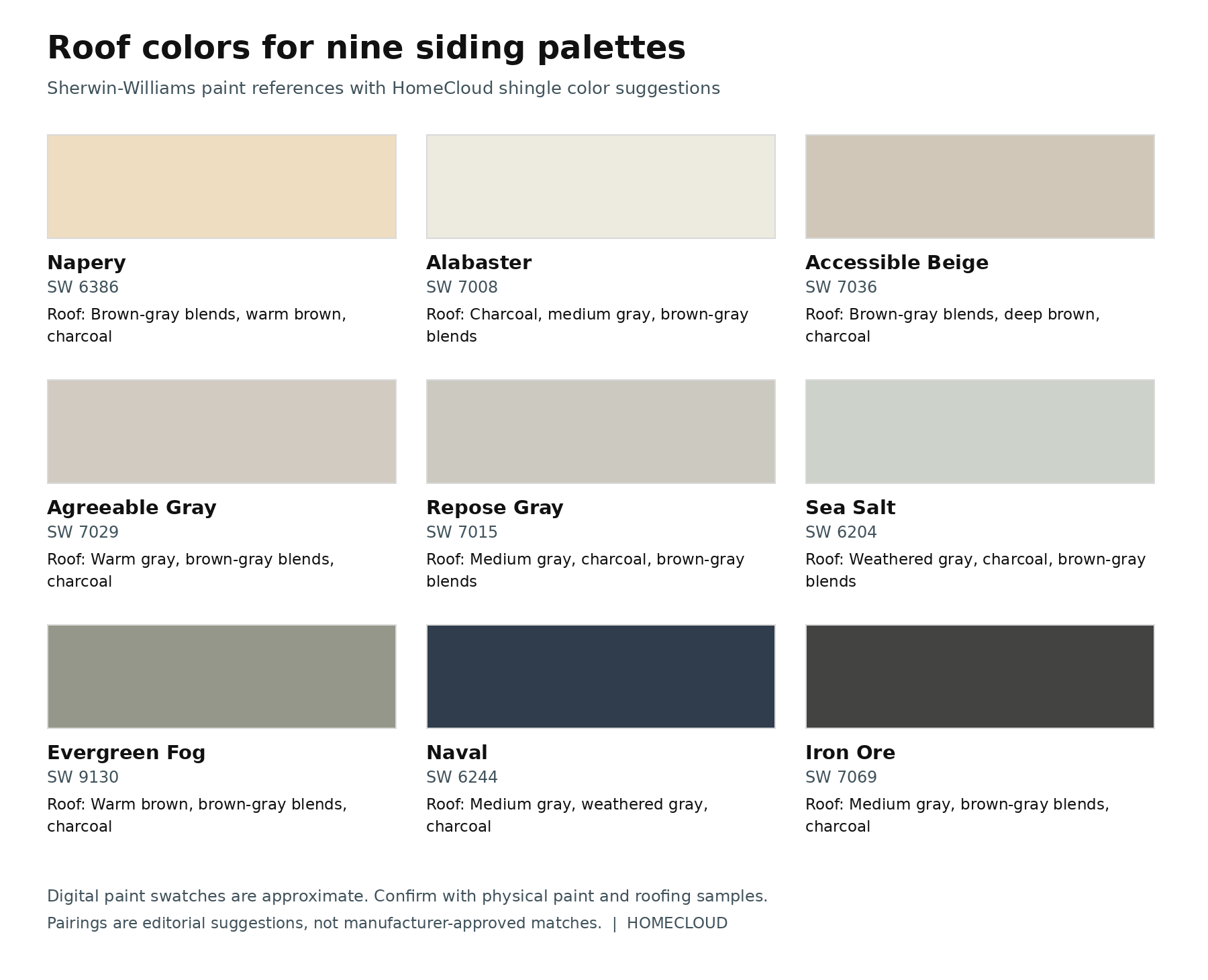
The swatches are screen approximations of each paint's published digital color, not color-accurate samples. Check physical samples in daylight.
These paint references do not mean every paint product or siding material can use every color. If you are repainting vinyl, check the siding manufacturer’s requirements and the approved paint system. Sherwin-Williams offers a specific VinylSafe palette, including selected darker colors; do not assume any dark paint is suitable for vinyl. [10]
What roof color works best with a yellow house?
The shade of yellow makes a difference. For a soft cream-yellow such as Napery, compare a muted brown-gray roof with charcoal. The first usually creates a gentler transition; the second emphasizes the roofline and light trim.
For a more golden yellow, add a warm brown sample to the comparison. If the home has cool gray stone, however, a strongly reddish-brown roof may introduce a competing undertone. Bring the stone into the decision instead of assuming every yellow house needs brown shingles.
A useful sample palette is Napery siding, Alabaster trim and either a brown-gray or charcoal roof. Compare both roof options on the house before deciding. The point is to choose the amount of contrast you prefer, not to find a shingle that exactly matches the siding.
Roof colors that work with different brick colors
Brick is usually a mixture of colors. Look at several bricks together, including their darker markings and the mortar. A single loose brick or a tightly cropped photo can give the wrong impression of the wall.
The table below offers design starting points. These are color families, not a promise that every product carrying that label will match.
| Brick appearance | Shingle families to compare | What to check on the house |
|---|---|---|
| Orange-red brick | Muted brown-gray, charcoal, deep brown | A strongly red roof can compete with the brick’s orange tones |
| Deep red or burgundy brick | Neutral gray, charcoal, restrained brown-gray | Compare samples for unwanted purple or red undertones |
| Salmon or pink-toned brick | Soft charcoal, medium gray-brown | Avoid adding another strong pink or red unless the combination is intentional |
| Brown brick | Weathered brown-gray, dark brown, charcoal | Create enough difference that the roof and walls do not merge visually |
| Tan, buff or cream brick | Warm gray, brown-gray, medium brown | Use the mortar and trim to judge how warm the roof should be |
| Gray brick | Neutral gray, charcoal, muted gray-brown | Check whether the brick reads blue-gray or warmer gray in daylight |
| Whitewashed or painted brick | Charcoal, medium gray, brown-gray | Check the white’s undertone and any original brick showing through |
| Strongly multicolored brick | A quieter gray, brown or charcoal blend | A less varied roof can keep the exterior from looking busy |
With red brick and white trim, charcoal is a useful first sample. It gives you a reference for strong contrast. Compare it with a muted brown-gray blend to see whether a softer connection to the brick works better.
Mortar deserves its own check. Pale cream mortar, dark gray mortar and pinkish mortar can make similar bricks feel very different. View the roof sample against the wall from several feet away so the brick and mortar read together.
Translate the palette into actual roofing products
Shingle manufacturers use their own color names and blends. As examples, GAF describes Charcoal as a black option, Weathered Wood as a brown-gray blend, Barkwood as a warm brown and Pewter Gray as a gray with additional blue and green tones. Those descriptions help you build a sample list; they do not establish an exact match to a paint color. [11, 12]
Ask for the exact manufacturer, product line and color. A color name by itself is incomplete, and another brand’s similarly named shingle may look different. Confirm that the chosen color is offered in the shingle line being quoted and is available for your project.
For example, “compare a brown-gray blend with charcoal” is a useful design direction. The final order should identify a particular shingle product and color, with the selection confirmed in writing.
A practical way to choose between the final two colors
- Gather large paint samples or identify the existing siding color. Include trim, brick, mortar and stone in the comparison.
- Request physical samples of two or three actual shingle blends. Include a darker option and a softer midtone if you are unsure about contrast.
- Have the samples positioned safely where you can see them with the exterior, ideally at an angle that approximates the roof. Do not climb onto the roof to test a color.
- Look from the street as well as up close. Recheck in sun, shade and overcast light.
- Use a manufacturer’s photo visualizer to compare the overall effect, then confirm with physical samples. Screens and printed swatches are approximations. [11]
- Confirm any applicable neighborhood or historic-district approval before ordering, and record the exact product and color in the contract.
A sample should resolve a specific decision: warmer or cooler, darker or lighter, quieter or more varied. Once those choices are clear, the remaining comparison becomes much easier.
The color choice belongs alongside the rest of the replacement scope. Keep the same flashing and water-management details in both proposals so a preferred color does not distract from what is actually being installed.
Sources
- Sherwin-Williams Napery SW 6386
- Sherwin-Williams Alabaster SW 7008
- Sherwin-Williams Accessible Beige SW 7036
- Sherwin-Williams Agreeable Gray SW 7029
- Sherwin-Williams Repose Gray SW 7015
- Sherwin-Williams Sea Salt SW 6204
- Sherwin-Williams Evergreen Fog SW 9130
- Sherwin-Williams Naval SW 6244
- Sherwin-Williams Iron Ore SW 7069
- Sherwin-Williams VinylSafe color guidance
- GAF roof color guide
- GAF descriptions of roof color families and exterior coordination
Planning a new roof? Start with what a roof replacement costs.
More roof resources
Get your roof priced
Tell us what's going on with your roof and we'll send you a priced estimate.
Get an Estimate